Every civilization builds coordination systems. Ours forgot the biggest one.
Every economy built coordination systems. The physical world never got one. UONEX is the real-time intelligence layer it requires.
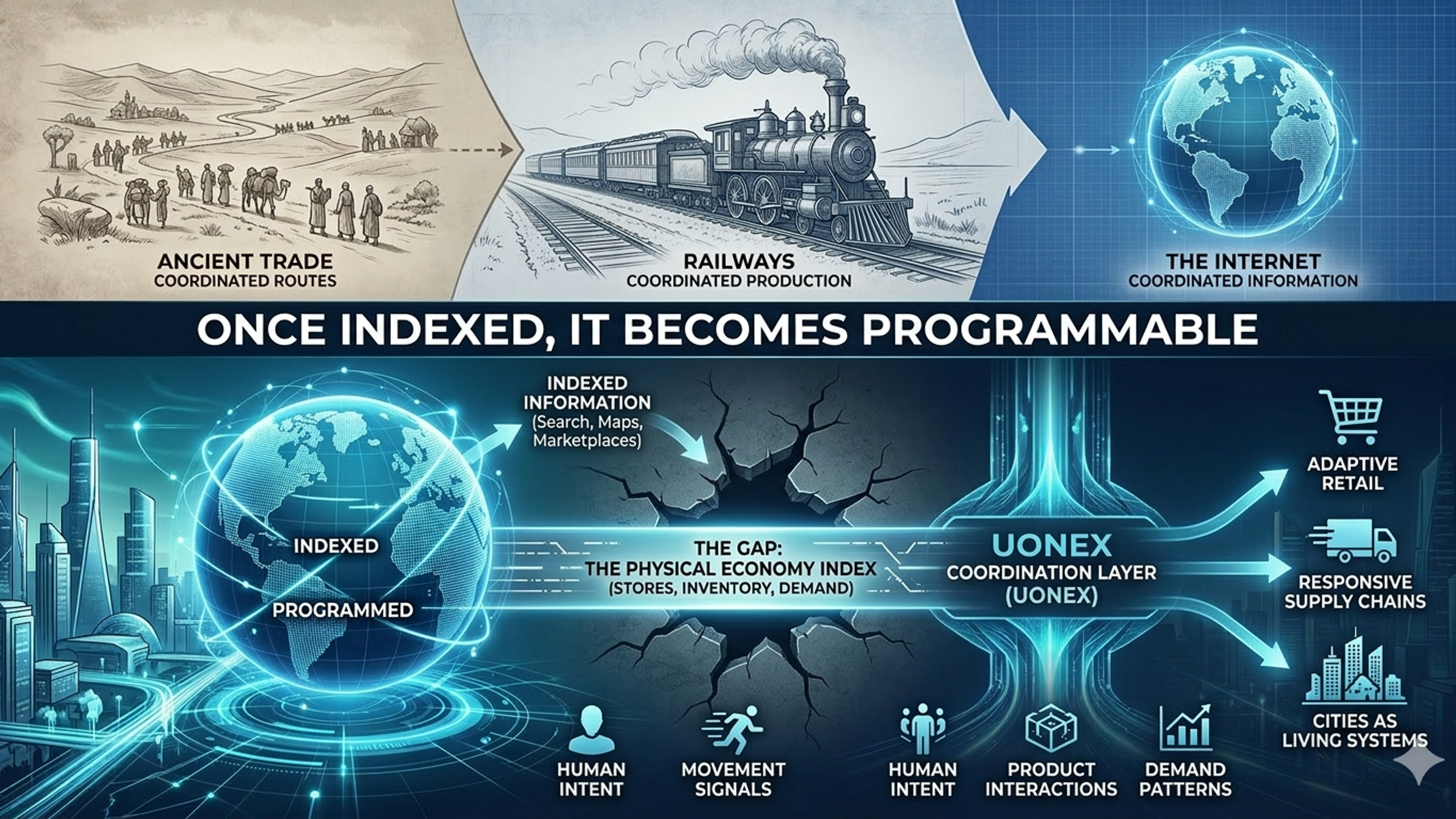
Markets coordinated trade routes. Railways coordinated production. The internet coordinated information.
Each generation built better ways to connect supply and demand. And each time, entire economies reorganized.
The internet introduced a powerful new mechanism for coordination: indexes.
Search engines indexed the web. Maps indexed geography. Marketplaces indexed products.
Once something gets indexed, it becomes programmable. Once programmable, entire industries reorganize around it.
But there's a strange gap hiding in plain sight. The physical economy - stores, inventory, real human demand - never got its index.
I've spent years inside this problem. The deeper you go, the more absurd the gap becomes.
A shopper expresses intent today. A retailer notices weeks later. A manufacturer adjusts months after that.
Demand moves slowly. Supply reacts even slower.
For most of history, this wasn't a failure of technology. It was simply a limitation of the physical world. The economy couldn't be observed in real time.
Artificial intelligence changes that.
For the first time, systems can interpret demand signals as they form. Human intent. Movement through environments. Product interactions. Patterns emerging across cities.
Individually these signals seem small. But connect them across millions of environments and something entirely new appears: a real-time intelligence layer for the physical economy.
This is what we're building at UONEX.
Not another marketplace. Not another transaction layer. A coordination layer.
The difference matters. Marketplaces help people buy things. Coordination systems connect demand signals to production… supply chains to local activity… retail environments to the people actually in them.
The economy shifts from reactive to responsive.
Think about what happens next. Retail districts begin adapting to shifting demand. Supply chains adjust in near real time. New experiences appear exactly where human interest emerges. Cities stop behaving like static infrastructure and start behaving like living economic organisms.
The counterintuitive part - this doesn't replace the human layer. It strengthens it.
When intelligence systems coordinate the infrastructure underneath, physical retail evolves beyond pure transaction. It becomes discovery. Creativity. Cultural expression. Shared experience. The things people actually want from the physical world.
The internet's job was connecting information. The next job is connecting the physical economy itself.
Advanced economies don't just benefit from intelligence systems that coordinate commerce at scale. They inevitably require them.
UONEX exists because this coordination layer is becoming necessary infrastructure.